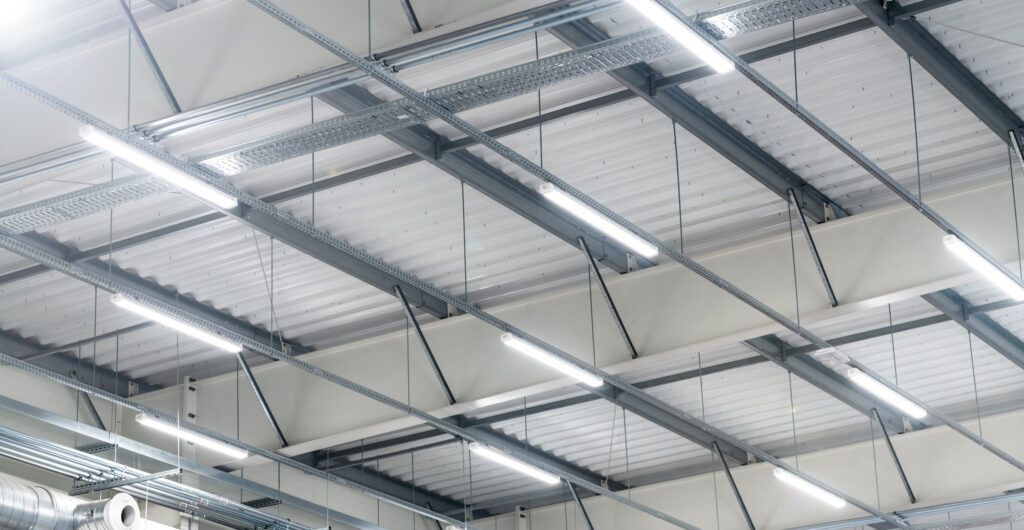
When it comes to protecting your facility, cameras and alarms are no-brainers. But have you ever considered the role that LED lighting can play in protecting your property and assets from theft or damage? High-quality LED lighting can offer serious protection in conjunction with other physical security features.
Breaking Down the Benefits
There are many advantages to using LED lights with surveillance cameras. They produce very bright white light that illuminates objects and colors more clearly than softer incandescent lights, allowing for better identification of suspicious persons and activity.
LED lights produce intense beams that you can easily direct to areas where more light is needed or away from areas that might interfere with cameras. LED lights can also be turned on or off instantly, which is excellent for motion detection.
The only significant disadvantage to LED lights is their brightness can cause glare on camera lenses, but you can remedy this by using multiple lights of a lower wattage in place of a few lights with high-powered beams.
Motion-activated lights are a great way to deter intruders without running up your electricity bill, but they will affect what kind of security camera you’ll need. Cameras with night vision will be necessary because they can survey even when lights are not on. Look for cameras with low-light sensitivity or infrared capabilities that adjust quickly to “daylight” when your lights are activated.
Accurate Positioning of LED Lighting
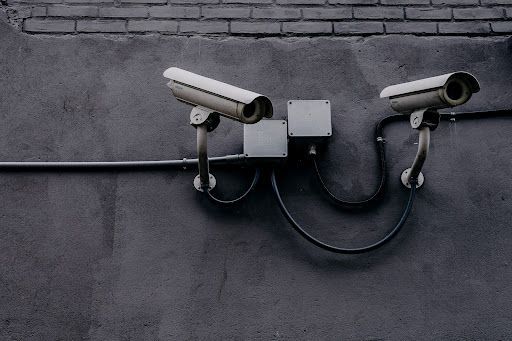
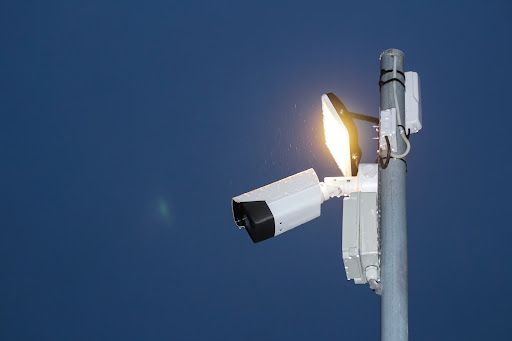
The rule of thumb for light positioning is to keep the light fixture out of view of the camera. This is best done by installing lights higher than the camera, allowing light to flood the camera’s range of view without shining too directly into the camera. You can also purchase lighting fixtures that have cameras built right in.
Cameras should also be positioned with extraneous lightings, such as for pedestrians and visitors, out of view. Lights like these can cause bright spots that become blind spots to camera images. Furthermore, lights should be positioned so they can be reached easily for maintenance but not so easily that they can be maliciously tampered with.
LED Lighting at Night
Security cameras can significantly deter wrong-doers, but sometimes you don’t want people to know the cameras are there. Infrared lights are a great option in areas where you don’t want a light that is visible to the human eye but still needs surveillance.
However, you will need cameras that are sensitive enough to detect infrared at night. Your best option, in this case, is a black-and-white camera, which can detect spectrums of light below red. With this capability, your cameras can view areas stealthily without any visible illumination.
Watch the Brightness
A light that is too bright and shines too directly at a camera can blind its view with blooming and streaking. Use shielded bulbs whose light is directed away from your cameras. Also, don’t install the brightest lights possible. A good rule of thumb is to use bulbs with .5 watts for every square meter (.05 watts for every square foot) of ground you want to illuminate. Anything higher is probably unnecessary and risks overwhelming your cameras.
At the same time, you don’t want to have too little lighting for your surveillance cameras. If your cameras do not have good low-light capability, you must ensure you’re illuminating their surveillance areas with strong enough lights to get a clear picture.
Work With Starbeam Lighting Experts
If you want to upgrade your facility’s security equipment, make sure proper cameras and lighting are part of your plans. You’ll also want to consult with experts that have experience with LED security lighting.
One of the things that our clients appreciate most about us is that we never take a cookie-cutter approach. No matter the space, the lighting style, the budget, the location, the natural light, and your individual aesthetic, we help you optimize outcomes with the best lighting solutions on the market. There is a reason we have been the go-to lighting solution in St. Louis for years. Contact us today to learn more!
The post How to Increase Security With LED Lighting appeared first on Starbeam Lighting.