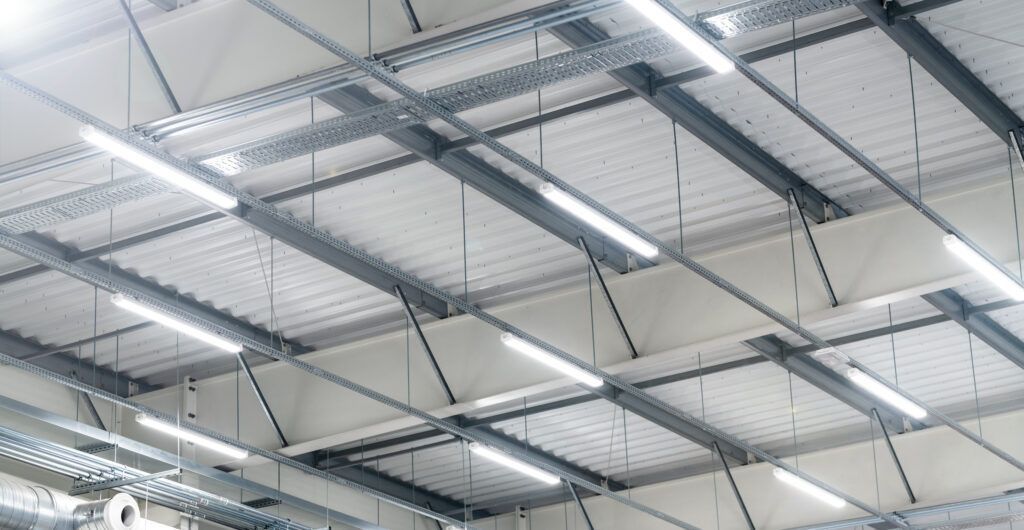
Think about your warehouse safety guidelines and practices — everything you do every day to remain compliant and keep employees safe. You consult OSHA regulations, complete comprehensive and ongoing training, maintain your equipment; there are plenty of moving parts when it comes to creating a culture of safety. Now think about your lighting: When was the last time you upgraded the lights and fixtures in your facility? It’s something that’s often overlooked, but still a crucial factor in your safety protocols.
If you’re still using traditional lighting or it’s been a while since you’ve replaced the lighting system in your warehouse, it’s time to consider how LED lighting can make it a safer place to work.
LED Lighting Reduces Fire Hazard Risks
Traditional industrial lighting emits 95% of the electricity used by bulbs as heat, wasting energy and getting very hot. LED lighting emits only 5% of electricity while converting the other 95% into light. Because of this, they’re much less likely to heat up to the point where they could cause a fire in your warehouse. All it takes is for one traditional light bulb or fixture to be installed incorrectly, come into contact with the wall, touch other materials in your warehouse, or lack the proper ventilation to start a fire.

LED Lighting Improves Working Conditions
Poor lighting levels in your warehouse and flicker from traditional lighting causes a list of health issues: headaches, fatigue, eye strain — all of these are hugely detrimental for employees who are already functioning in a high-risk workplace. LED lighting is flicker-free and helps mitigate these health issues; in turn, employees take fewer sick days, are less prone to burnout, and overall more efficient and productive. Switching to LED lighting can create lighting in your warehouse that’s very similar to natural light.
LED Lighting Supports Temperature Control
The same heat that causes a fire risk when traditional lighting is used also wreaks havoc on a warehouse’s temperature control system. Frequent fluctuations happen, especially in facilities with older HVAC systems or even those without air conditioning altogether. This is not only an issue for facilities that store perishable items, it can also make employees very uncomfortable and even be dangerous. Hotter working conditions mean more strain on HVAC systems, higher energy bills, and less productive workers. LED lighting makes it much easier to maintain a temperature-controlled environment with fewer fluctuations.
LED Lighting Reduces Loss of Inventory
When inventory in your warehouse goes missing or gets damaged, your organization suffers a financial loss and your customers will take notice that their products don’t arrive on time — or at all. Traditional lighting dims over its lifetime, making it hard to locate items on high shelves or in dark corners. Employees spend valuable time looking for those items and productivity diminishes, or they may just decide that items were lost. LED lighting in your warehouse illuminates those darker, harder-to-reach areas to easily locate inventory.

LED Lighting Mitigates Accident Risk
All the warehouse equipment training in the world won’t stop an accident from happening if the lighting in your warehouse facility is poor or too dim. Aisles are tight and workers are constantly moving around the warehouse transporting inventory, and without the right lighting in place, equipment operators and forklift drivers can easily hit shelving, piles of pallets, or even other employees. LED lighting can offer visibility for operators to make quick reactions that avoid dangerous accidents.
Other Safety Benefits of LED Lighting
There are many smaller ways that LED lighting in your warehouse can enhance safety. Because incandescent and fluorescent bulbs are made of glass, they can shatter easily upon impact. LED lighting is generally made of shatterproof materials and tends to be much more durable; an important consideration in industrial and warehouse applications. LEDs also weigh less than traditional lighting which makes it easier to install and change out. They also require less energy to operate, and can easily illuminate a warehouse for a long duration on backup power alone, allowing for easier and safer evacuation in the event of an emergency.
Ready to take extra steps to enhance the safety of your warehouse or industrial facility? Speak with our team about upgrading your lighting to LEDs. We have the experience and the expertise needed to evaluate your current lighting system and offer LED options that will provide safe working conditions with the addition of improved energy efficiency.
The post Improving Warehouse Safety With LED Lighting appeared first on Starbeam Lighting.