Sustainability seems to be on everyone’s mind lately, and that’s a good thing. Books, articles, classes, and consultants are sharing the benefits for individuals and businesses alike. There’s so much information, and so many options, that it can be confusing to pick a starting point on the path to sustainability. Here’s your lightbulb moment: the answer may be as close as your light fixtures, and enlisting the help of our team of professionals at Starbeam Lighting.
Sustainability in Business
Before we go much further, let’s establish a working definition of what sustainability is. The School of Sustainability at Arizona State University distills this complex concept to a concise set of principles that are often known as the triple bottom line (3BL). It can be expressed as three distinct pillars:
- People: Beneficial to our neighbors
- Planet: Good for the environment
- Profit: Your sustainability initiatives should make economic sense
In order to be most effective, a sustainability solution should meet each of these three criteria. And, as ASU notes, “Sustainability is not about doing ‘less bad.’ It is about doing ‘more good.’”
Lighting and Sustainability
Now that we have some idea of how sustainability works, how does your industrial or commercial lighting fit into the big picture? Let’s start by looking at the Planet pillar from our definition above. The IIDA cites a Department of Energy study that pegs global energy use for lighting alone at $230 billion per year. Here in the states, annual energy costs for lighting hover in the 20-25% range. A number of developments — LEED standards, energy efficiency requirements, and high-efficiency lighting — all aim to reduce energy consumption; this, in turn, would mean the need for less energy generation, less use of fossil fuels to generate that energy, and a lower environmental impact due to extraction and burning of those fossil fuels.
Technology alone isn’t the answer, however. One reason that Starbeam Lighting conducts lighting audits is because many businesses, warehouses, and manufacturing facilities are incorrectly lit. Poor lighting is wasteful, but it also has health and safety implications for your business. Your personnel suffer (the People “P”), and so does your bottom line due to accidents, lost productivity, and lower morale (there’s your Profit “P”).
Sustainable Lighting Products
Sometimes the results of your lighting efficiency audit will surprise you. That’s due, in part, to the fact that more light fixtures won’t always be the solution. From time to time, we find that making intelligent use of available light through windows and skylights can cut back on daytime light use.
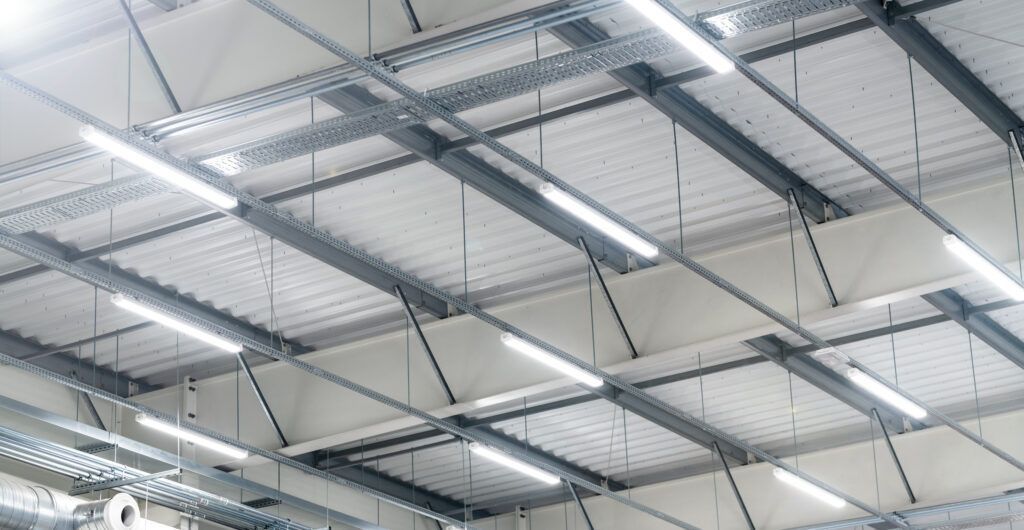
Other times, a lighting retrofit can result in significant savings. Modern LED fixtures consume far less energy than their traditional counterparts. But even a poorly-conceived LED retrofit can pose issues since the wrong fixtures (like a high bay light when a pendant would be more effective) can also lead to poor light and resource use.
Finally, timing matters. Many businesses have areas that are perfectly lit, but they’re lit when they don’t need to be. The cost in wasted light and energy adds up quickly. A task bay that’s only occasionally used, a supply closet that’s used even less frequently than that, and even your employee restrooms can benefit from smart lighting and smarter lighting controls that cut back on wasted energy.
Getting Started
There’s another core sustainability principle that binds all the others together: It works best when it’s a group effort. No single company or individual can make a more sustainable industry, much less a sustainable world. Sustainability is collaborative by definition and requires an all-hands-on-deck approach. The good news is, if your business is looking for the cost savings and environmental benefits of sustainability, you don’t have to go it alone. Starbeam Lighting can illuminate your path to sustainability through energy-efficient industrial lighting . Call us for a consultation today!
The post Industrial Lighting and Sustainability appeared first on Starbeam Lighting.