Evolution Of TLEDs. The last several years have seen a marked increase in the popularity of TLEDs, also known as “T8 LED tube lights”. Starbeam Lighting reviews the evolution of this lighting solution and discusses why TLEDs are a compelling choice for businesses interested in a new approach to industrial lighting .
What Is a TLED?
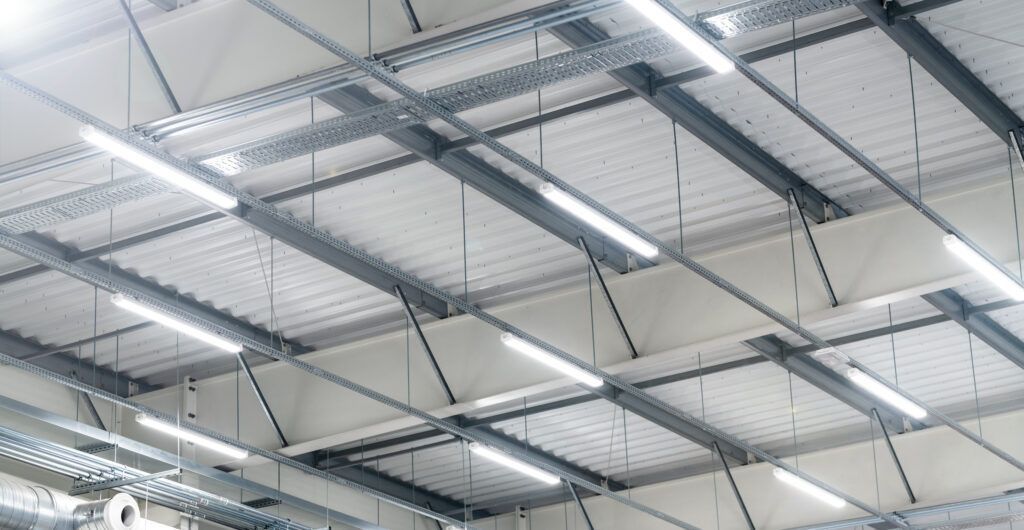
A TLED represents the “evolution” of the traditional linear fluorescent lamp. TLEDs look like their predecessors and are designed to fit into the same fixtures, yet they are 30% more efficient than linear fluorescents and are mercury-free. Also, TLEDs are solid-state, which means they can provide directional lighting as well as integrate with automated controls (i.e. motion sensors or a dimmer). The advantages offered by TLEDs have made them a popular choice for retrofitting warehouses and office buildings still using traditional linear fluorescent lamps.
TLEDs – Early Challenges
When TLEDs first began attracting attention in 2013, there were various shortcomings which needed to be overcome. These included:
Application: LEDs were acknowledged to work best when designed around the installation site’s requirements for light output and thermal control, as opposed to being “forced into” existing fixtures like the traditional linear fluorescent lamp, i.e. for retrofitting.
Safety: when they first appeared, TLEDs were considered an “independent product” – one which sometimes, but not always, carried DLC and UL safety approval.
Compatibility: Early TLEDs faced compatibility issues with the fixtures they were serving as retrofits for, to the point where they needed to be rewired in order to work.
Lifespan: The first TLEDs suffered from a lifespan that was far shorter than that possessed by traditional T8 lamps.
Efficiency: similar to their lifespan issues, TLEDs also didn’t produce nearly as much light as a T8 system. This fact negated the advantage offered by TLED in terms of better energy efficiency.
Overall, it was understood by our lighting company and many others that, paraphrasing the Department of Energy’s (DOE) findings at the time, “TLEDs are improving, but cost, life, and performance are not yet superior”.
Today’s TLEDs
Given the lighting industry’s optimistic view of TLED’s possibilities, it only took a few years to solve the aforementioned challenges. Whereas manufacturing cost used to be high and efficiency low, future evolutions of the TLED resulted in a solution that today is inexpensive to manufacture while delivering excellent energy efficiency. In fact, a typical LED nowadays uses only 19 watts to output more than 100 lumens per watt, resulting in an impressive 80+ CRI.
Also, whereas the first TLEDs required a ballast, design advancements soon resulted in a “ballast-free” product that today offers greatly reduced cost and minimal maintenance. Moreover, today’s TLEDs are UL listed and DLC qualified, which means they’re eligible for a variety of utility company rebates.
All of these advantages, coupled with an increasingly diverse product mix and a simple means of installation, makes it easy to understand why the DOE today confirms TLEDs as one of the fastest-growing LED products in the U.S.
Explore TLED With Starbeam Lighting Today
As experts in industrial lighting fixtures and solutions, Starbeam Lighting knows TLEDs inside and out. Trust us to help you incorporate these LED products into a solution that increases safety and efficiency, while decreasing cost and maintenance.
The post The Evolution Of TLEDs appeared first on Starbeam Lighting.