Types Of Industrial Lighting Fixtures. If you’re looking to install industrial lighting in an office building, warehouse, or factory, you’ll need the expertise possessed by Starbeam Lighting. We’re licensed, bonded, and highly proficient with a variety of industrial lighting types and installation procedures. And speaking of “lighting types”, let’s take a look at the most common types of industrial lighting in-use today.
Full Spectrum Industrial Lighting
Ideal for offices and buildings/areas where foot traffic is frequent and employees spend a lot of time looking at computers and other screens, full spectrum industrial lighting comes very close to replicating natural light. This lighting option can be deployed on a large scale, or in smaller, “individualized” solutions such as swing-arm desk lamps.
LED Lighting
As we move further into the 21 st century, more and more companies are switching to LED for their industrial lighting fixtures . By far the most popular choice and easily the most eco-friendly, LED also has a big advantage in terms of customization: they come in a large variety of designs, colors, and sizes, making them configurable to virtually any kind of workplace and any type ambiance. Moreover, they consume a low amount of power, produce far less heat than, say, a traditional incandescent bulb, and offer an impressively long lifetime.
From factories and office buildings, to trade show floors and sports arenas, LED lighting’s many benefits are being discovered by new users every day.
Fluorescent Lighting
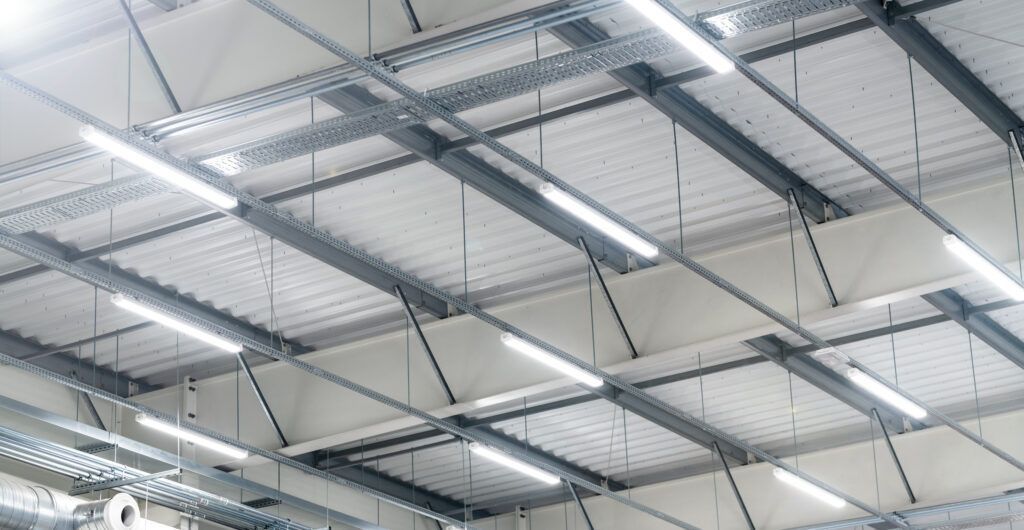
When you need to illuminate a large area, fluorescent lighting is the perfect choice. They’re also quite energy efficient (not at LED’s level, but close) and they are quick to reach maximum intensity, which is why they’re often found in supermarkets, department stores, and similar product-oriented environments.
Halogen Lighting
Halogen lighting is commonly used in spotlights of varying sizes (from the large spotlights employed by car dealerships, to the small spotlights used on theater stages) because of their ability to produce very bright light. They’re upside is also their downside, as such intensity brings with it high glare and considerable heat, which makes halogen lighting a poor fit for any locale in which people would be close to the light, or have to rely on it to see. Interestingly, halogen lights boast low energy consumption – significantly lower than you might think.
Incandescent Lamps
This is the “original lightbulb”, these days used mainly in homes and less so in an industrial setting. A simple wire filament conducts an electric current that warms the filament and causes it to produce light. These lights score poorly in lifespan and efficiency, and retrofits – in which a newer lighting solution, i.e. LED, replaces an outdated one – are becoming increasingly popular related to incandescent lamps.
High Intensity Discharge (HID) Lighting
HID lighting is a definite improvement on incandescent, with HID being more energy efficient and longer-lasting. Often found in outdoor artificial lighting and landscape lighting, HID lighting comes in a few varieties, such as mercury, high-pressure sodium, and metal halide.
Leverage Our Lighting Expertise
Starbeam Lighting has long served the lighting needs of businesses throughout the St. Louis metro area. With over 1000 years of collective experience, our lighting company is the one to talk with about design solutions, energy incentives, and the latest lighting products that will help keep your business running at top speed.
The post The Most Common Types Of Industrial Lighting Fixtures appeared first on Starbeam Lighting.