The Last Time You Checked Your Warehouse Lights? Many businesses take their warehouse lighting for granted, but with cost-saving, energy-efficient LED lighting widely available on the market, it might be time to check your commercial light fixtures and make a change. To that end, here are four questions Starbeam Lighting thinks you should ponder.
What Kind Of Warehouse Lighting Do You Currently Have?
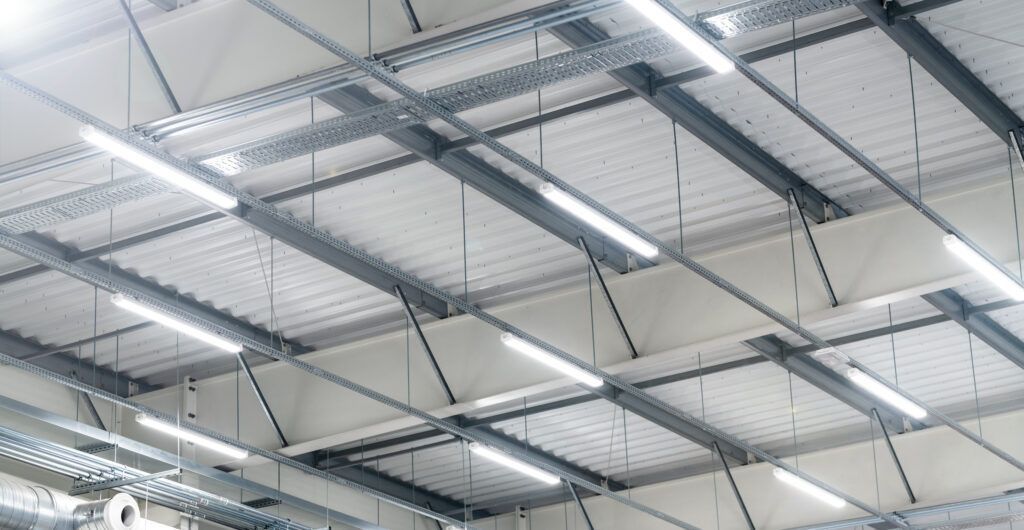
You’d be surprised how many warehouse managers are unable to answer this question. Over time, warehouse lighting becomes an afterthought – plus, new personnel might not have any idea what the previous management installed. You may need to pull old purchase orders, make a few calls, or contact your local lighting supplier for a consultation, but ultimately the answer to this question might be, “HID or fluorescent.” If this is the case, then now is a great time for an LED upgrade. HID and fluorescent are inefficient, expensive, and in some cases even dangerous. On the other hand, LED lighting offers energy, cost, and maintenance savings, along with superior light quality, easy integration with other systems, and simple controllability.
Are Your Warehouse Lights On 24/7?
If so, you’re wasting energy and money. The solution, and one that in some instances can deliver an 80 percent reduction in warehouse energy usage, is to add lighting controls so you can configure your warehouse illumination to your specific needs. There’s no sense paying for light you don’t really use, and LED systems come with easy-to-use controls to ensure you’re always maximizing your energy usage and budget.
This also holds true for warehouses with lighting that is controlled by a manual switch. Instead of worrying about “the last one out turning the lights off,” an automated system does it for you. Plus, you can adjust your lighting setup depending on time of day, season, occupancy, and big events like monthly inventory.
Is Your Warehouse Lighting Too Dim?
Insufficient brightness in the warehouse can negatively impact several areas, the most important of which is safety. Lighting should never be the cause of an employee accident or injury, but in too many warehouses employees have a hard time seeing and navigating, which leads to trouble. Inefficiency is another detriment: in an inferiorly lit warehouse, employees make more mistakes during inspections, pull the wrong products, take longer to pull a product, are unable to read the numbers on a label – the list goes on.
Compounding this problem is the fact that fluorescent and HID lighting dulls much faster than LED, plunging the warehouse into a steadily increasing dimness. And although the human eye will acclimate to changing lighting conditions, this doesn’t replace losses in terms of efficiency or safety. When you install new lights, you’ll be pleasantly surprised by how big a difference they make.
Are Any Of Your Warehouse Lights Out Right Now?
If the answer is “yes,” now is the perfect time not only to replace the expired lights, but to also do so with high-powered, high-upside commercial LED lighting from Starbeam Lighting. Contact our lighting pros today and we’ll help boost your warehouse’s visibility, safety, and productivity.
The post When’s The Last Time You Checked Your Warehouse Lights? appeared first on Starbeam Lighting.